When we talk about skin aging, we usually think of UV radiation, free radicals, or environmental influences. One factor, however, often goes unmentioned: stress – and the stress hormone cortisol. Its role in skin health is more significant than commonly recognized.
Cortisol influences key processes in the skin — from barrier function and inflammatory responses to regenerative capacity. Especially during prolonged mental or physical strain, persistently elevated cortisol levels can affect the skin’s appearance. The skin often becomes less resilient, regenerates more slowly, and gradually loses firmness and radiance.
What Is Cortisol — and How Does It Work in the Body?
Cortisol is produced in the adrenal cortex and is one of the body’s primary stress hormones. It ensures the body can rapidly access energy in stressful situations. Our sleep–wake cycle is also closely linked to cortisol: levels rise in the morning — a natural mechanism that prepares the body for the day ahead. In the evening, cortisol levels drop again – and it is precisely this decline that signals the skin to initiate key repair processes such as cell renewal and DNA repair.
When Stress Becomes Chronic
Short-term releases of cortisol are normal and important. Issues arise when cortisol levels remain elevated over time — for example due to ongoing psychological stress, lack of sleep, or an imbalanced lifestyle. Chronically increased cortisol levels can strain the body on many levels — including the skin.
Cortisol and Skin Aging: Effects on Key Skin Functions
Scientific studies show that chronic stress is associated with measurable changes in the skin barrier, epidermal lipid composition, and regenerative capacity.
Persistently elevated cortisol levels can significantly compromise key skin functions:
- Barrier Function: Cortisol reduces epidermal lipids and structural proteins, leading to increased transepidermal water loss (TEWL).
- Inflammation Regulation: Stress-related cortisol release triggers neurogenic inflammatory processes and mast cell activation. In the long term, this can result in a chronic, low-grade inflammatory burden — a process referred to in research as inflammaging and increasingly recognized as an independent driver of premature skin aging.
- Regeneration & Aging: Chronic stress is associated with reduced collagen synthesis, slower cell renewal, and activation of collagen-degrading enzymes (e.g., matrix metalloproteinases). Over time, the skin loses firmness and structural integrity.
As a result, the skin may react more sensitively, lose elasticity and firmness, and appear drier or more breakout-prone. The skin's natural regenerative capacity can also be gradually impaired.
How Stress-Related Skin Changes May Appear
Stress-related changes are not always immediately obvious. They often develop gradually and present subtly — a pattern also described in clinical observations under chronic strain:
- The skin appears tired or dull despite an unchanged skincare routine
- A feeling of tightness occurs without classic dryness
- Regeneration slows, for example after poor sleep
- The skin reacts more sensitively or becomes more prone to blemishes
Even previously stable skin can become temporarily disrupted under prolonged strain.
„Cortisol Face“ – A Lifestyle Term
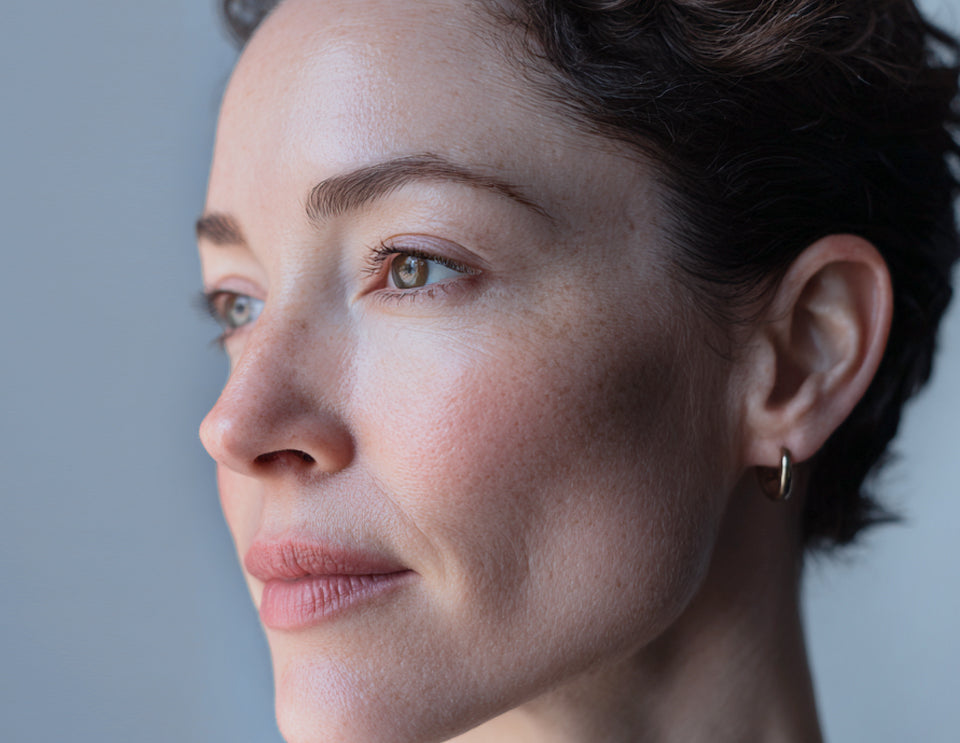
In lifestyle media, visible signs of stress in the face are increasingly described as „Cortisol Face“ The term refers to changes such as dull skin, fine lines, puffiness, or an overall reduced radiance. While not a medical term, it reflects growing awareness that persistent stress can become visible in the skin — often as the result of several processes acting simultaneously.
Stress Reduction as Part of Skincare
Skincare alone cannot regulate cortisol — but a conscious lifestyle can help support hormonal balance. Some approaches include:
- Movement: Moderate physical activity helps reduce stress (especially morning exercise).
- Daylight: Morning light exposure supports a natural cortisol rhythm.
- Nutrition: A balanced diet with sufficient protein and complex carbohydrates can help stabilize energy levels.
- Sleep: Adequate, restorative sleep supports regeneration — including that of the skin.
Skincare During Periods of Increased Stress
During phases of heightened strain, the skin benefits above all from a reduced, clearly structured routine. The focus should be on formulations that support the skin barrier, limit transepidermal water loss, and protect the skin from additional oxidative stress. What matters most is not the number of products, but their compatibility and formulation quality.
Final Tip: The „Cortisol Cocktail“
As part of a stress-conscious morning routine, one drink has become widely popular: the so-called “cortisol cocktail”. Its combination of fluids, electrolytes, vitamin C, and magnesium makes it a popular option for starting the day well.
Recipe idea for a great start to the day:
- 200 ml coconut water
- Juice of ½ lemon
- 50 ml orange juice
- 1 teaspoon magnesium powder
- ¼ teaspoon fine salt
- Top up with sparkling water to taste
Whether this cocktail measurably influences cortisol levels has not been scientifically proven. However, it may help support fluid and mineral balance in the morning — a small, enjoyable contribution to a more stress-conscious daily routine.
Conclusion: Stress cannot always be avoided — but it can be better understood and more consciously managed. Anyone thinking long term about skin health should also consider internal factors such as cortisol and stress. Healthy skin is always, in part, a reflection of internal balance.
Sources:
- Stress-Induced Changes of the Skin: A Narrative Review, Cureus, 2025
- Psychological Stress Deteriorates Skin Barrier Function by Activating 11β-Hydroxysteroid Dehydrogenase 1 and the HPA Axis, Journal of Investigative Dermatology, 2018
FAQs:
Can skincare lower cortisol levels?
Skincare does not directly intervene in hormonal regulation. However, it targets exactly where chronic stress affects the skin: barrier function, transepidermal water loss, and stress-related inflammatory processes. High-quality, barrier-supporting formulations can stabilize the skin and strengthen its resilience during periods of increased strain.
How quickly does the skin recover after a stressful period?
This varies individually and depends on the duration and intensity of the stress. With targeted care, the skin barrier can stabilize within a few weeks. Deeper changes, such as reduced collagen synthesis, take considerably longer. The key factor is reducing the stress trigger itself. Skincare is an effective lever — in combination with lifestyle factors.
Does stress-related skin aging only affect mature skin?
No. Chronic stress can affect the skin at any age. Barrier impairment, increased sensitivity, and slower regeneration are not age-dependent — they can occur whenever cortisol levels remain persistently elevated.
Can cortisol be measured in the skin?
Yes, through stratum corneum analysis. In scientific studies, cortisol in the stratum corneum is analyzed using tape stripping to examine local stress responses in the skin. This method is primarily used in research settings. Studies show a significant correlation between local cortisol levels and increased TEWL.